

Follow-up questions after NPS, CSAT, and CES: data from 5,253 live surveys
Written by Moritz Dausinger, CEO of Refiner ·
There’s plenty of advice on adding an open question after an NPS or CSAT score, and very little data on what teams actually write in it. To get some, I took every survey built in Refiner between February 2019 and September 2026, kept the 5,253 that collected at least 10 responses (about 15 million responses between them), and coded every follow-up question by what it asks. That’s 8,574 rating questions and every text and multiple-choice question that comes after them, in 35 languages.
Quick answer: the best follow-up question after a rating
Ask one open question, right after the score, and match it to the score:
| Score | Ask | Example |
|---|---|---|
| Low (detractors, dissatisfied, hard) | What went wrong | “Sorry to hear that. What made [the export] hard?” |
| Middle (passives, neutral) | What would move the score | “What would make it a 10?” |
| High (promoters, satisfied, easy) | What they value, then a review ask | “What do you like most about [Product]?” |
| No branching | The reason, tied to the thing you asked about | “What’s the main reason for your score on [the new editor]?” |
If you can’t branch, “What’s the main reason for your score?” is the safest single question. It works for every score, and it’s the most common follow-up teams settle on for NPS.
For the full checklist, skip to the follow-up question best practices.
About the data
The dataset is every survey created in Refiner from February 2019 to September 2026: 32,236 surveys and 143,504 questions and screens.
- Rating questions are NPS, CSAT, CES (any rating about ease or effort), PMF (“How disappointed would you be if you could no longer use…”), and other star or number ratings.
- A follow-up is the question that comes right after the rating. When the survey uses logic to send people down different paths based on their score, every question on those paths counts as a possible follow-up.
- When several ratings come in a row (a five-question CSAT grid, for example), I look at what comes after the last one.
- I only count surveys with 10 or more responses. Half of all surveys never got a single response, and drafts and tests would skew every number.
- Each follow-up question was coded by meaning, in its original language, into intents: reason, improve, problem, value, open comment, feature request, and a few smaller ones. The full list is in the method notes.
There’s no company identifier in the data, and one company can run hundreds of copies of the same survey. To keep a single account from tipping the results, intent shares count each unique question once. Structure numbers (how many ratings get a follow-up) count every rating question.
The data shows how surveys are set up, not how people answered them. Which follow-ups get the longest or most useful answers is the next study.
1 in 5 ratings get no follow-up
After the last rating question in a survey, here’s what comes next:
| Next step | Share of rating questions |
|---|---|
| Open text question | 40% |
| Multiple-choice question | 15% |
| Logic that branches into open text questions | 15% |
| Logic that branches into multiple choice only | 4% |
| Nothing: thank-you screen, or logic that only leads to thank-you screens | 19% |
| Yes/no, button, or contact form | 5% |
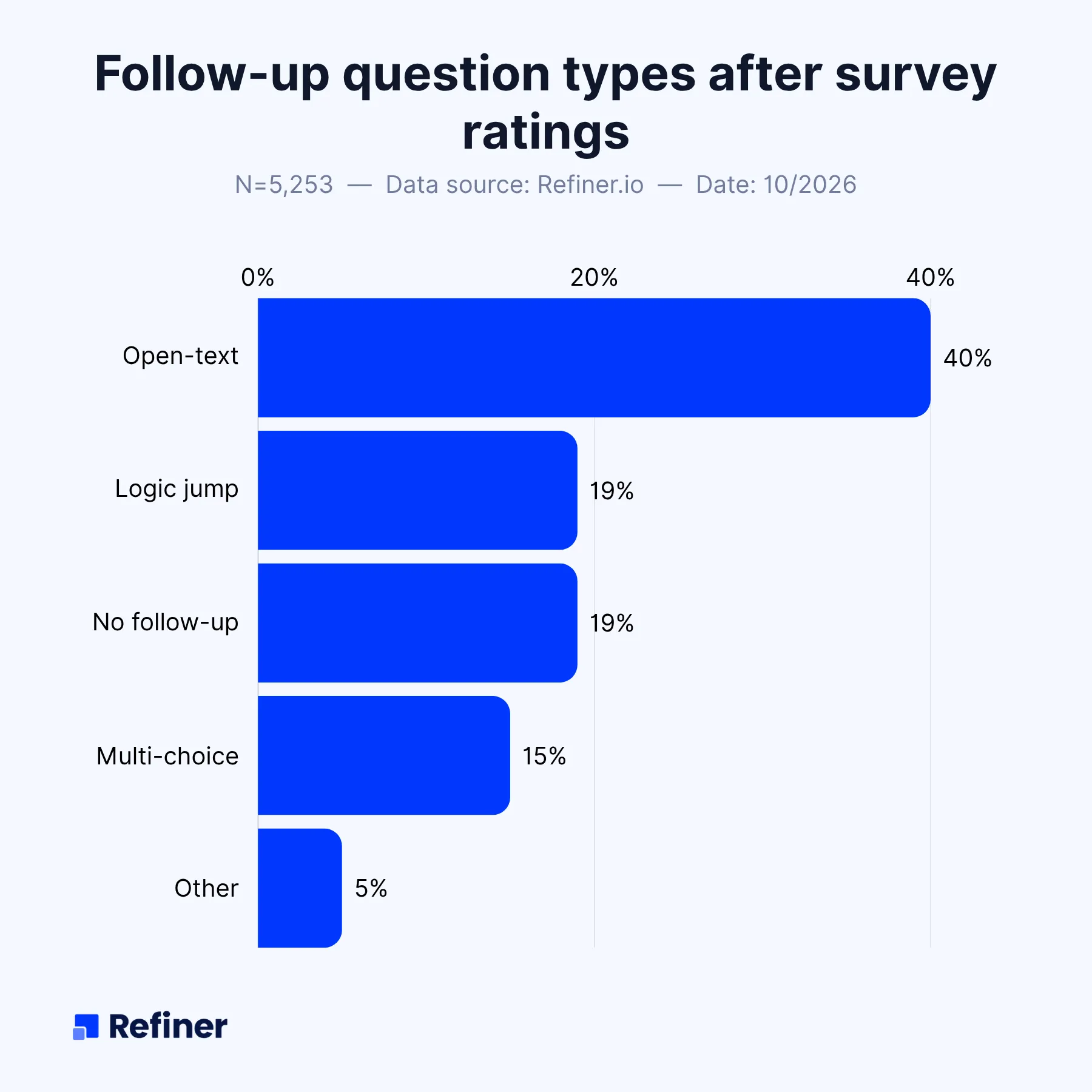
19% of rating questions end with a thank-you screen. Those surveys get a number and no way to explain it. If an NPS score drops 8 points next month, a survey like that can’t tell you why.
That share doesn’t depend on how big the survey is. It sits at 19% to 20% for surveys with 10 to 99 responses, 100 to 999, and 1,000 or more. Bigger programs skip the follow-up just as often as small ones.
It does depend on the metric:
| Metric | No follow-up question |
|---|---|
| PMF | 36% |
| CSAT | 26% |
| CES | 22% |
| Other ratings | 19% |
| NPS | 15% |
PMF is the worst offender, which is odd. Sean Ellis’s PMF survey is built around the follow-ups: what’s the main benefit you get, who would benefit most, what would you use instead. The “very disappointed” percentage tells you whether you have fit. The follow-ups tell you who it’s with and why.
Teams ask about improvement first
Across all metrics, unique follow-up questions ask for:
| Intent | Example | Share |
|---|---|---|
| Improve | “What can we do better?” | 27% |
| Open comment | “Anything else you’d like to share?” | 20% |
| Reason | “What’s the main reason for your score?” | 19% |
| Value | “What do you value most about [Product]?” | 14% |
| Problem | “What issues did you run into?” | 6% |
| No question at all | “Thanks for your feedback!” above a text box | 5% |
| Feature request | “Which features would you like to see added?” | 3% |
| Other (use case, alternatives, contact, review, unrelated questions) | 6% |
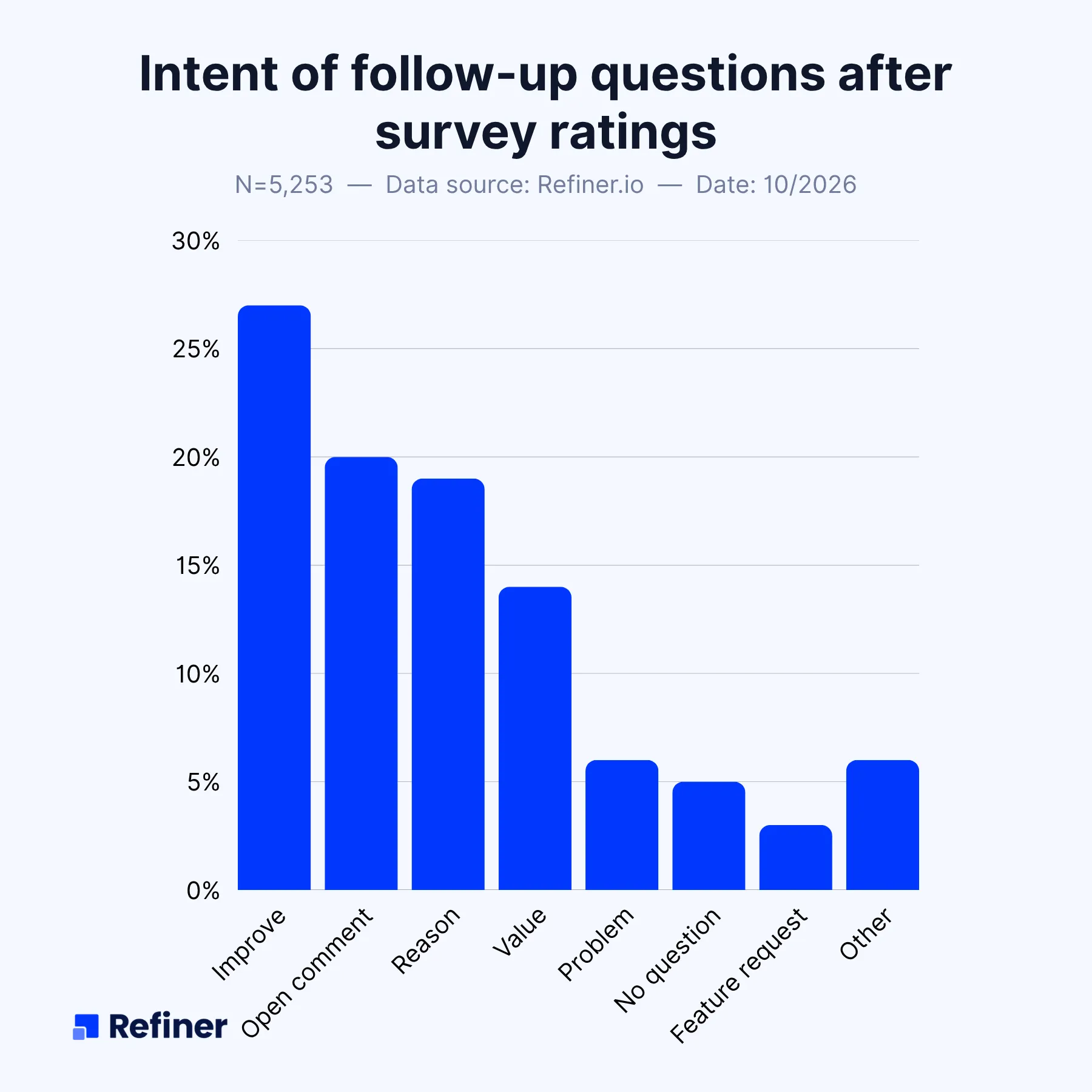
Improvement and open comments make up almost half of all follow-ups. Both are reasonable, but they ask the respondent to do the analysis. “What can we do better?” asks someone who gave you a 9 to come up with a complaint. “Anything else?” asks them to decide what’s worth saying. A reason question ties the answer to the score they just gave, which makes it easier to answer and easier to group later.
About 1 in 20 follow-ups has no question at all. The text box sits under “Thanks for your feedback!” or “We’re sorry to hear that …”, and the respondent has to guess what to type.
NPS asks for the reason, CSAT and CES ask for fixes
| Metric | Reason | Improve | Open comment | Value | Problem | Unique questions |
|---|---|---|---|---|---|---|
| NPS | 30% | 22% | 19% | 19% | 3% | 417 |
| CSAT | 18% | 35% | 23% | 8% | 6% | 303 |
| CES | 18% | 41% | 15% | 7% | 11% | 103 |
| Other ratings | 14% | 22% | 20% | 13% | 7% | 358 |
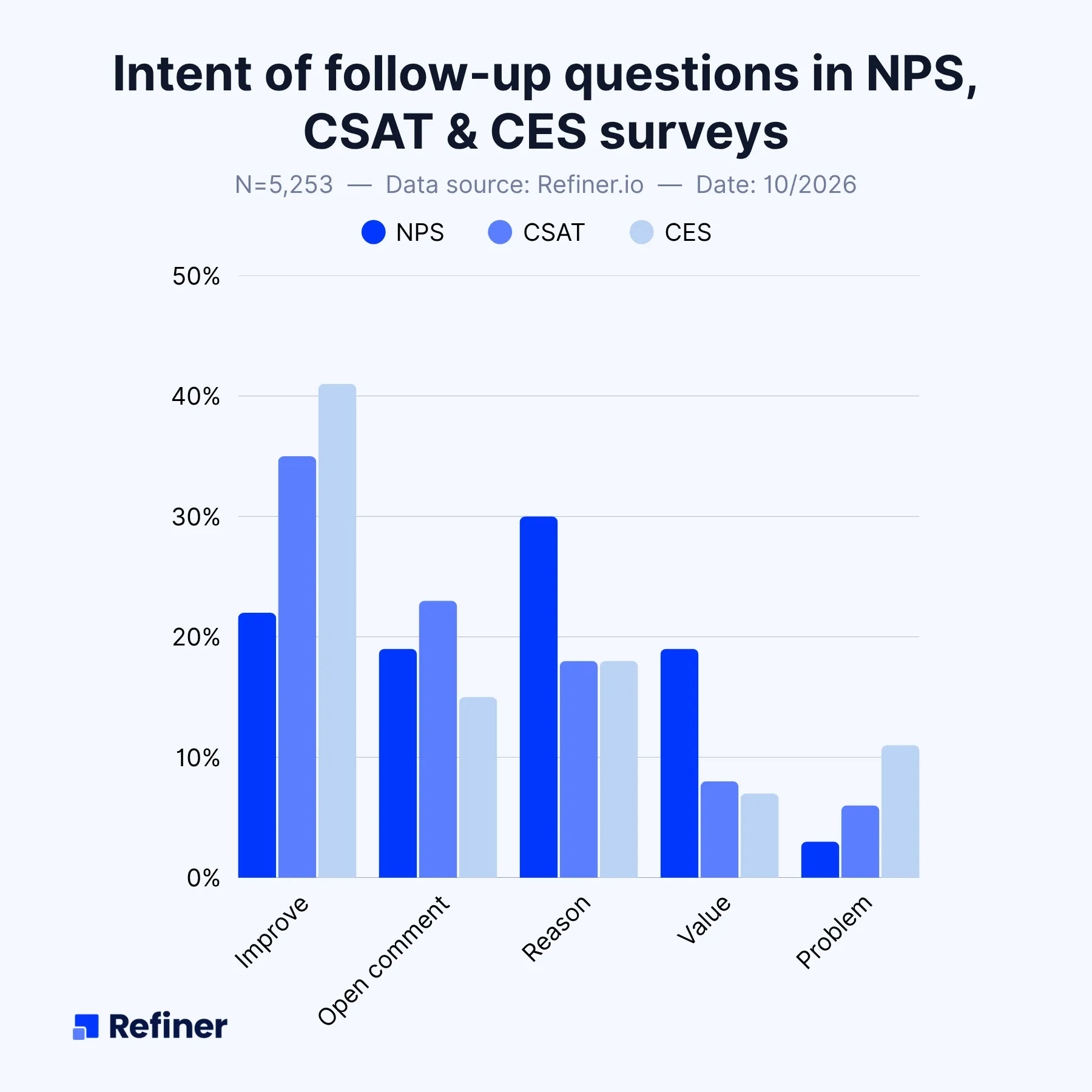
NPS follow-ups ask for the reason more than anything else. Counting repeated questions too, it’s 39% of NPS follow-ups, and 48% if you leave out the three most repeated questions in the dataset. “What is the main reason for your score?” and its translations are the standard, and teams copy them.
The NPS follow-up I’d avoid is the value question asked to everyone. “What do you value most about our service?” makes sense for a promoter. Asked to someone who just scored you a 3, it reads like you didn’t look at their answer. 19% of unique NPS follow-ups ask about value, and 95% of those go to every respondent, whatever the score.
CSAT and CES lean toward improvement. That fits how they’re used: CSAT after a support ticket or a task, CES after someone uses a feature. The rating is about one moment, so “what would have made this better?” has an obvious subject. CES also has the highest share of problem questions (11%), like “What made it difficult?”, which makes sense for a metric about effort.
Ratings also come in clusters. In 27% of cases, a rating question is followed by another rating, usually a grid of CSAT items (“Rate the speed / the price / the support”). Grids are fine, but put the open question after the last item, and ask which item drove the low score.
Most follow-ups ignore the score
When the follow-up comes straight after the rating, with no logic in between, 97% use wording that fits every score. Only 2% are written for unhappy respondents and 1% for happy ones.
That’s the default you get when you add one text question and move on. It’s also why so many follow-ups are generic (“Anything else?”, “What can we do better?”). A question that has to work for both a 2 and a 10 can’t say much.
The fix takes a minute: add logic after the rating and write one question per score range.
Branching changes the question
15% of rating questions are followed by logic that branches into different open questions. Those branches look very different from single follow-ups.
| Branch written for | Top intent | Share | Next most common |
|---|---|---|---|
| Low scores | Problem (“What went wrong?”) | 48% | Reason 24%, improve 15% |
| Passives | Improve (“What would make it a 10?”) | 77% | Reason 21% |
| High scores | Value (“What do you love about it?”) | 41% | Reason 19%, improve 16% |
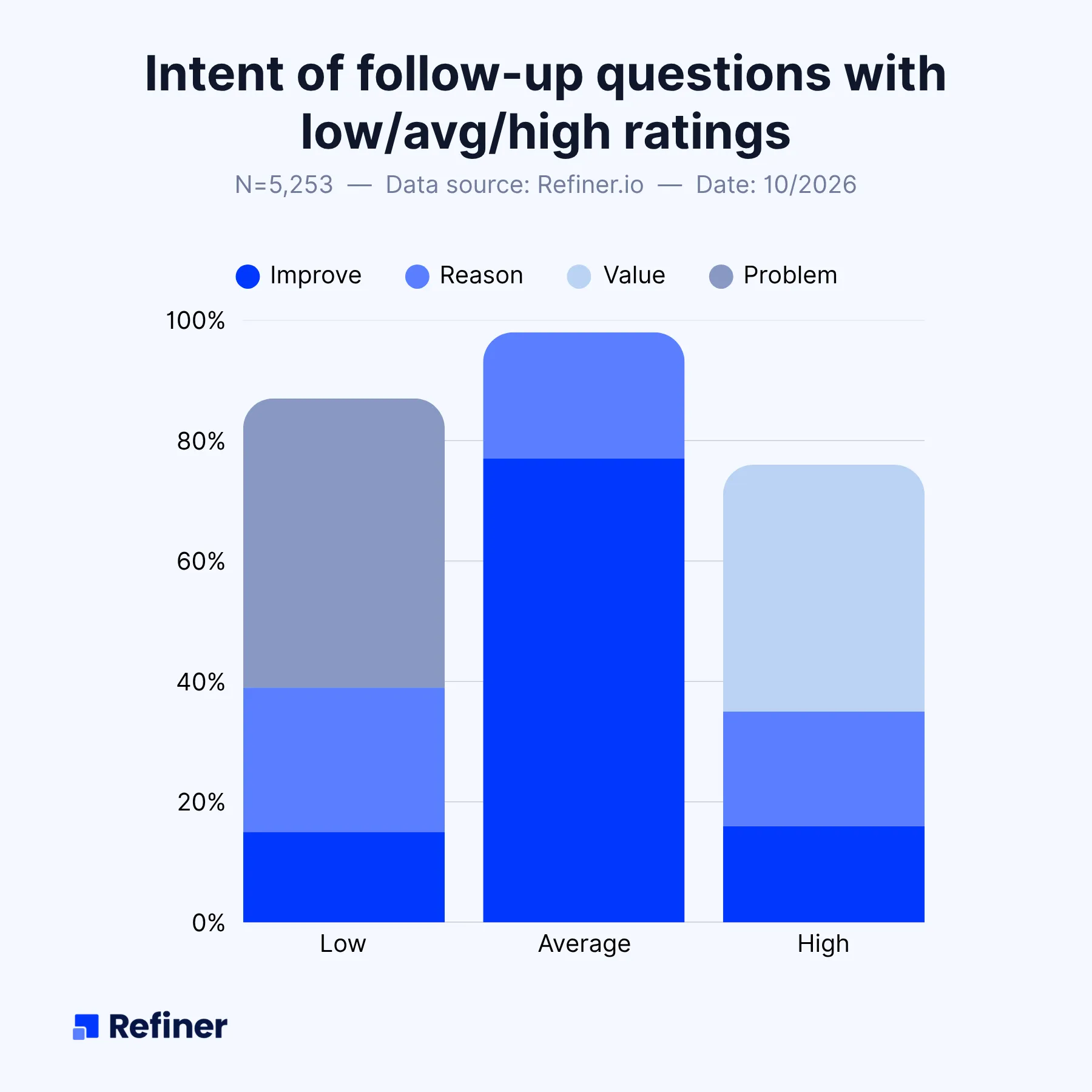
High-score branches rarely ask for anything. Only 4% of unique high-score branch questions ask for a review, testimonial, or referral. Someone who just gave you a 10 is the easiest person you’ll ever ask for a G2 review, and most surveys thank them and close.
A lot of branches have no question. 17% of high-score branches and 10% of low-score branches show only “That’s great to hear!” or “Sorry to hear that” above a text box. Write the question.
Branch examples worth copying:
- Low: “We are sad things are not going great. Could you tell us more?”
- Low: “What was missing or disappointing in your experience with us?”
- Passive: “We’re close! What would take us to a 10?”
- Passive: “What’s missing for it to be a 9 or 10?” (translated from Swedish)
- High: “What do you like the most about [Product]?”
In Refiner, you set this up with survey logic after the rating question. Set the score ranges, then add one text question per path.
“Why?” questions rarely name anything
Reason questions are short (7 words on median) and almost all of them point at the score: “Why did you give that score?” Only 4% name what the score was about.
| Intent | Median words | Names a feature, page, or moment |
|---|---|---|
| Feature request | 14 | 49% |
| Problem | 10 | 40% |
| Improve | 9 | 24% |
| Value | 9 | 17% |
| Open comment | 7 | 13% |
| Reason | 7 | 4% |
That’s fine when the rating question already names the thing (“How easy was it to set up your first report?”). It’s a problem when the rating is about “our service” or “your experience,” because then the follow-up is generic too, and the answers will be all over the place.
By metric, CES follow-ups name something specific most often (29%), and NPS least often (9%). NPS is about the whole relationship, so that’s expected. For CSAT (16%), it usually means a missed chance: the survey fires after a specific moment, and the follow-up doesn’t mention it.
Other wording habits:
- 25% of follow-ups refer back to the score or answer (“that score,” “your rating”).
- 8% ask two things in one question, usually “What did you like and what should we improve?” Split them into two questions or two branches.
- 1.6% say the question is optional. If the follow-up isn’t required, add “(optional)” so people know they can skip it.
- 0.1% use personalization like the person’s first name or plan.
- 40% aren’t in English. Spanish, French, German, Portuguese, and Thai are the most common after English.
Multiple choice and other follow-up formats
15% of rating questions are followed by a multiple-choice question instead of open text. Only 10% of those ask for the reason (“What part of your experience shaped your score the most?”). The most common are a question on a different topic (30%), a value question (26%), or a profile question like role or company size (12%).
A multiple-choice reason question is a good idea when you already know the main drivers: price, support, a specific feature. It’s fast to answer and easy to chart. Add an “Other” option with a text field so you still catch what you didn’t think of, and put the open question after it.
Email, mobile, and web surveys ask different things
Follow-ups that come straight after the rating, by where the survey runs:
| Channel | Reason | Improve | Open comment | Value |
|---|---|---|---|---|
| 50% | 15% | 14% | 12% | |
| Mobile app | 40% | 24% | 15% | 15% |
| Hosted link | 33% | 13% | 10% | 24% |
| Web app | 28% | 22% | 24% | 16% |
| Website | 19% | 22% | 31% | 7% |
Email surveys ask for the reason half the time. In-app web surveys spread their follow-ups across reason, improvement, and open comments. Website surveys lean on “anything else?”, which is the weakest choice for visitors who may not even be customers yet.
Follow-up question best practices
- Add a follow-up after every rating. 19% of rating questions in live surveys don’t have one, and those surveys can’t explain a change in the score.
- Keep it to one open question per path. Add an optional “Anything else?” at the end if you want, but never as the only follow-up.
- Ask for the reason when you can’t branch. “What’s the main reason for your score?” fits every score and is the most common NPS follow-up (30%).
- Branch on the score when you can. Ask low scorers what went wrong, passives what would make it a 10, and high scorers what they value. 97% of single follow-ups use the same wording for every score.
- Don’t ask everyone what they value. It only fits promoters, and 95% of NPS value questions go to every respondent.
- Ask happy respondents for a review. Only 4% of high-score branches do.
- Name the thing you’re asking about. Only 4% of reason questions mention a feature, page, or moment, which leaves the answer as vague as the question.
- Write an actual question in every text box. 1 in 20 follow-ups shows only “Thanks for your feedback!” or “Sorry to hear that” above the box.
- Ask one thing at a time. 8% of follow-ups ask two things, usually “what did you like and what should we improve?”
- Mark optional questions as optional. Only 1.6% do.
- Put the open question after the last item in a rating grid, and ask which item drove the low score.
- Use multiple choice for reasons only when you already know the main drivers, and keep an “Other” option with a text field.
Follow-up questions to copy, by metric
These follow the response rate playbooks from last year’s study: one rating, one follow-up, shown at the right moment. Short surveys performed best in that study, so each playbook keeps it to one open question per path.
NPS follow-up questions
- Everyone (no logic): “What’s the main reason for your score?”
- Detractors (0 to 6): “Sorry to hear that. What’s the biggest thing we’re getting wrong?”
- Passives (7 to 8): “What would make it a 10?”
- Promoters (9 to 10): “What do you value most about [Product]?” then a review or referral button.
Avoid asking every respondent what they value. Detractors get a question that doesn’t fit their score.
CSAT follow-up questions
- Everyone: “What’s the main reason for your rating of [the support chat]?”
- Dissatisfied: “What could we have done better with [your ticket]?”
- Satisfied: “What did we get right?”
Name the moment. CSAT runs after something specific happened, so the follow-up should say what.
CES follow-up questions
- Hard (low ease scores): “What made [creating a report] hard?”
- Easy: skip the follow-up, or ask “Anything we could make even faster?” as optional.
CES is the one metric where I’d only require a follow-up on low scores. The problem answers are the ones you’ll act on, and 11% of unique CES follow-ups already ask about problems directly.
PMF follow-up questions
- “What’s the main benefit you get from [Product]?”
- “What would you use if [Product] were no longer available?”
- “How can we improve [Product] for you?”
Ask these after the “How disappointed would you be” question, and read the answers from the “very disappointed” group first. They tell you who your best customers are and what they’d miss. Without them, the PMF score is just a percentage, and 36% of PMF questions in the dataset stop there.
Open comment (“Anything else?”)
Keep it as a last, optional question, after a reason or problem question. As the only follow-up, it leaves the respondent to work out what you want.
Real follow-up questions from the dataset
The most used follow-ups in live surveys, by intent. Product names are replaced with [Product], and non-English questions are translated.
Reason:
- “What is the main reason for your score?”
- “Why did you give this score?” (French, German, Spanish, and Italian versions are all in the top 10)
- “Thanks! A few words to explain your vote?” (French)
- “What part of your experience shaped your score the most?”
- “What happened that led to your score?”
Improve:
- “What could have been better? (optional)” (German)
- “What can we do better?”
- “What could we do to improve your experience?”
- “What could make the repayment process more convenient for you?”
Problem:
- “We are sad things are not going great. Could you tell us more?”
- “What issues did you face with [Product]?”
- “What did you try, and why do you think it didn’t work?” (Romanian)
Value:
- “What do you like the most about [Product]?”
- “What are we doing well?”
Open comment:
- “Is there anything else you would like to share with us to help us serve you better?”
- “Anything you want to add?”
- “Do you have any more feedback for us?”
Feature request:
- “What else would you like to see that is currently not available in our offers?”
- “What new features or services could improve your experience with [Product]?”
- “[Product] aims to be everything for your adventures. What do you feel is missing for that claim to be true?”
Use case:
- “How might you use this?”
- “What do you most want to get out of this program? (Please be as specific as you can)”
Review or referral (rare):
- “Would you share a testimonial about your experience below for us to potentially feature in marketing materials?”
Method notes
- Source: Refiner survey configuration data, February 2019 to September 2026. 32,236 surveys, 143,504 questions and screens.
- Live surveys: 10 or more responses. A response counts the first answer. 5,253 surveys with a rating question meet that bar.
- Rating families: NPS and CSAT by question type. CES is any rating about ease or effort. PMF is the “How disappointed would you be” question in any language. Other ratings are everything else on a star or number scale.
- Follow-ups: the next question after the last rating in a row. When logic follows the rating, every question on the possible paths counts, up to the next rating.
- Intent coding: each unique question was coded by meaning in its original language, with one primary intent and optional secondary ones. Coding also recorded the score range the wording targets (low, middle, high, or any), whether it names something specific, and whether it refers to the score. A sample was checked by hand.
- Intent shares count each unique question once, so repeated surveys from one company don’t skew them. Structure and channel numbers count every rating question.
- Limits: the data shows survey setup, not answers. There’s no company identifier. Logic rules aren’t in the export, so the score range a branch targets comes from its wording.
FAQ
What is the best follow-up question for NPS?
“What’s the main reason for your score?” It works for every score, and it’s the most common NPS follow-up in Refiner’s data (30% of unique NPS follow-ups, 39% counting repeats). If you can branch, ask detractors what went wrong, passives what would make it a 10, and promoters what they value.
Should I ask a follow-up question after every rating?
Yes. 19% of rating questions in live surveys don’t, and those surveys can’t explain changes in their score. One optional open question is enough.
How many follow-up questions should I ask?
One per path. Last year’s response rate study found short surveys get the best response and completion. Add an optional “Anything else?” at the end if you want, but not as the only follow-up.
Should the follow-up be different for detractors and promoters?
Yes, if you can set up logic. 97% of single follow-ups use the same wording for every score. Surveys that branch ask low scorers about problems, passives about what’s missing, and high scorers about value, and each question fits the person reading it.
Open text or multiple choice for the follow-up?
Open text by default. Use multiple choice when you already know the main reasons people give, keep an “Other” option with a text field, and follow it with an open question if the survey is short enough.
What should I ask after a CSAT question?
Ask about the moment the survey covers: “What could we have done better with [your ticket]?” 35% of unique CSAT follow-ups ask what to improve, but only 16% name the interaction they’re about.
What should I ask after a CES question?
“What made it hard?” for low scores. You can skip the follow-up for easy scores, or make it optional.
 NPS Email: All You Need to Know (with Examples)
 How to Calculate NPS (incl. NPS Formula for Excel)
 What is an NPS Detractor: How to Turn Detractors in NPS into Promoters
 How to Set Up NPS Goals for SaaS
 How to Use NPS in Customer Service
 Why Use NPS: 7 Reasons to Use NPS Surveys
 6 Examples Of Transactional NPS Questions (And When To Use Them)
 CSAT vs. NPS: Similarities and Differences
 Best Time to Send NPS Survey: Guide with Examples
 What is a Good NPS Score for SaaS: NPS Benchmarks for SaaS Companies