
Survey Call-To-Action (CTA)
Introduction
Section titled “Introduction”Adding a Call-To-Action (CTA) element to your survey is an effective way to drive user engagement and encourage follow-up actions.
Common use cases include:
- Asking satisfied users to leave a review
- Redirecting users to a specific page in your app
- Offering discounts, rewards, or special promotions
- Encouraging users to book a demo or contact support
CTA Element Layout
Section titled “CTA Element Layout”A CTA element consists of two main sections.
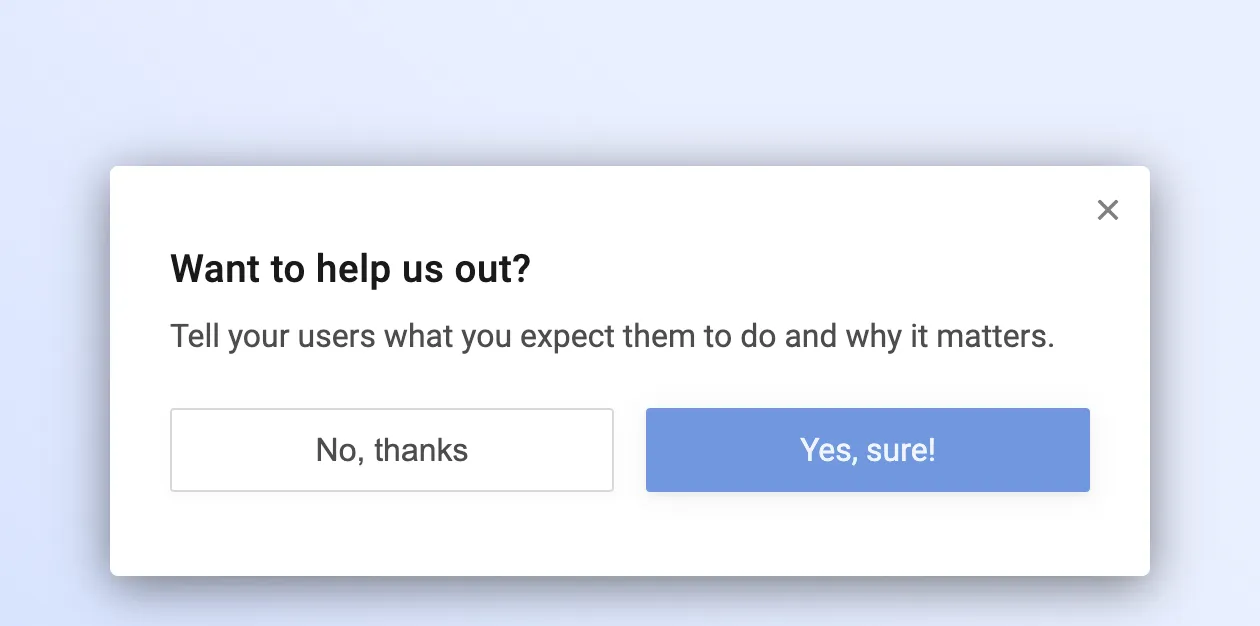
The content top section can contain:
- A headline
- Body text
- A banner image (optional)
- A short video (optional)
Below the content area, you can configure:
- A primary button that opens the target URL
- An optional secondary button that simply continues the survey flow without opening a link
Web App Surveys
Section titled “Web App Surveys”For web-based surveys, the CTA button can open both relative and absolute URLs.
Supported formats:
- Relative URLs starting with
/ - Absolute URLs starting with
https://
Examples:
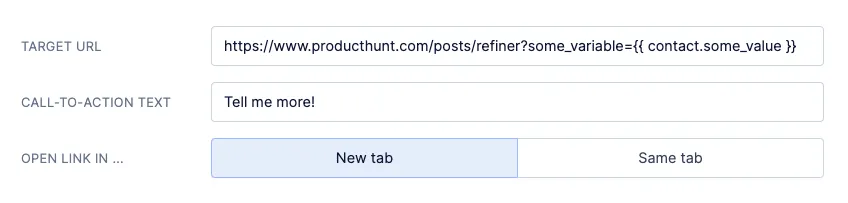
/settings/billinghttps://www.example.com/pricingYou can also choose whether the target URL should open:
- In the same browser tab
- In a new browser tab
Mobile App Surveys
Section titled “Mobile App Surveys”In mobile app surveys, CTA URLs are opened directly by the operating system. Normal web URLs (https://…) are opened by the web browser app of the mobile device.
Custom URL schemes such as:
myapp://settingswork reliably on Android.
However, on iOS, deep links targeting the same app that currently displays the survey are restricted and may fail silently.
For the best cross-platform experience for deep links, use an https:// URL configured as:
- a Universal Link on iOS
- an App Link on Android
This allows users to be routed directly to the correct in-app screen without opening the browser.
As an alternative, you can also leave the Target URL empty and handle CTA navigation yourself using the SDK’s onComplete callback.
Personalized Data in URLs
Section titled “Personalized Data in URLs”CTA URLs support Liquid Tags, allowing you to pass personalized user data directly into the target URL.
Example:
https://www.some-url.com?user_id={{ contact.id }}&user_email={{ contact.email }}The available syntax and variables are identical to the Liquid Tags supported in the survey body text.