Dashboard Data Filters
Introduction
Section titled “Introduction”Dashboards come with a global filter sidebar and a date range setting. Together they control which survey responses are shown across all charts on a dashboard, so you can quickly drill down into your data and compare different time periods.
Filter sidebar
Section titled “Filter sidebar”Click Filter data in the top navigation of a dashboard to open the filter sidebar. Filters apply to all charts on the dashboard, except charts that overwrite the dashboard filters.
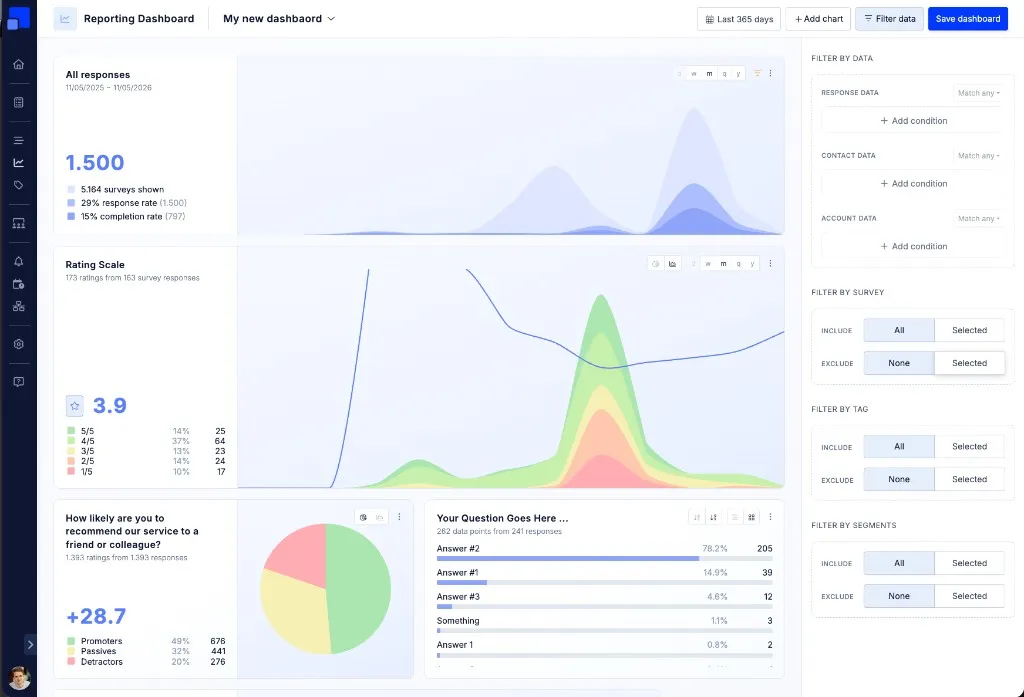
The sidebar groups filters into the following sections:
- Filter by data: Response data, Contact data and Account data
- Filter by survey: Include or exclude surveys
- Filter by tag: Include or exclude tags
- Filter by segment: Include or exclude user segments
These are the same filters you know from the Survey Responses page.
Filter by data
Section titled “Filter by data”Data filters narrow down responses based on the data stored with them:
- Response data: Answers given to survey questions, identified by their question identifier.
- Contact data: Traits stored on the user profile, such as plan, role or signup date.
- Account data: Traits stored on the account a user belongs to. This group only appears if you send account data to Refiner.
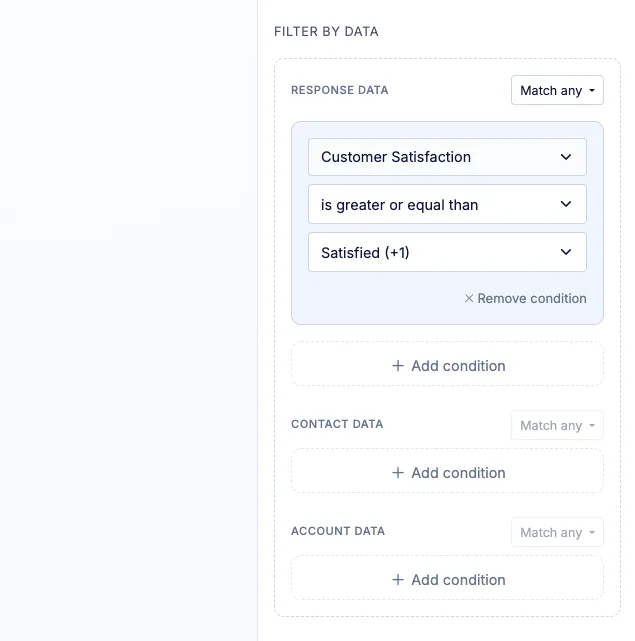
Click Add condition, then choose a data identifier, an operator (for example “is equal to”, “is greater than” or “value exists”) and a value. You can add up to five conditions per group. The Match any or Match all setting of each group decides whether a response needs to match at least one or all of its conditions. The Response Data Filters article lists all available operators.
Filter by survey, tag and segment
Section titled “Filter by survey, tag and segment”The survey, tag and segment filters each have an Include and an Exclude option.
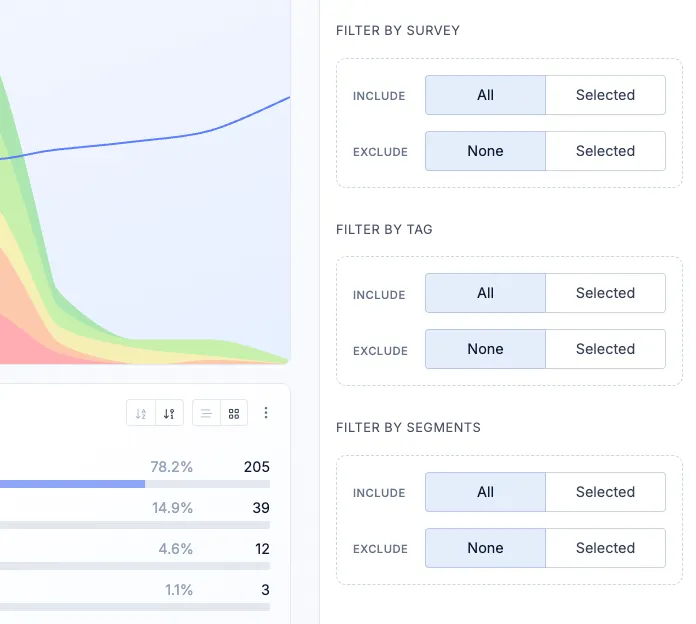
- Include: Choose Selected and pick one or more items to only use responses that match at least one of them. All turns the filter off.
- Exclude: Choose Selected and pick one or more items to leave out responses that match any of them. None turns the filter off.
The survey filter matches the survey a response was given to, the tag filter matches the tags added to a response, and the segment filter matches the user segments the respondent currently belongs to.
For example, you could build a dashboard that includes all your NPS surveys, excludes the segment “Internal users” and excludes the tag “Spam”.
How filters are combined
Section titled “How filters are combined”All filter sections are combined, so a response needs to match every active filter to be included in your charts.
Save filters
Section titled “Save filters”Dashboard filters are saved with the dashboard. When you change a filter, a Save dashboard button appears in the top navigation. Click it to keep your changes for you and your team. If you leave the page without saving, Refiner asks you to confirm before discarding your changes.
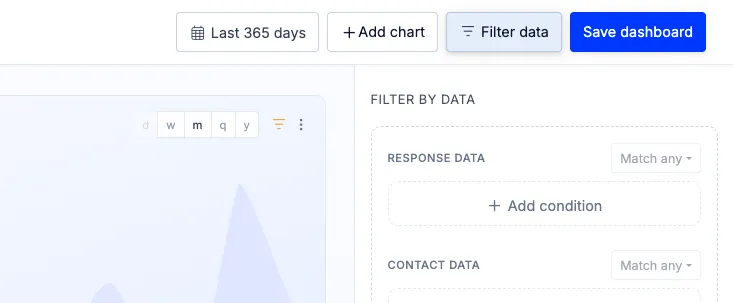
Chart-level filters
Section titled “Chart-level filters”If a single chart needs different filters than the rest of the dashboard, you can overwrite the dashboard filters for that chart. This lets you, for example, compare trial users and paying customers side by side on the same dashboard.
Date range
Section titled “Date range”The global date range applies to all charts included on a dashboard.
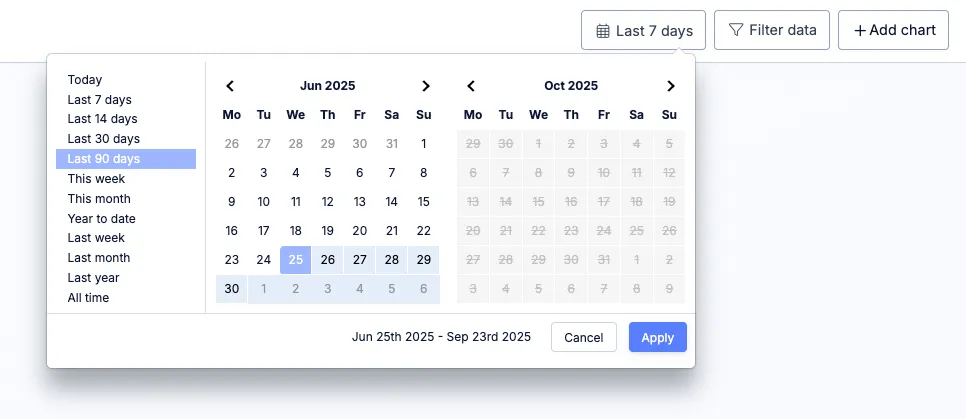
The following default date ranges are available on the left side of the date range filter:
- Today
- Last 7, 14, 30, 90 days
- This week, this month, year to date
- Last week, month, year
- All Time
You can also choose a custom date range with the calendars on the right side of the panel.
Refiner uses the “last shown” date of survey responses as a reference date for data analysis. Please note that the “last shown” date of a survey response can be updated over time, for example if you are using our Follow-Up Mode. Survey responses counted in a specific date range at a given time might slide into a newer date range later on.
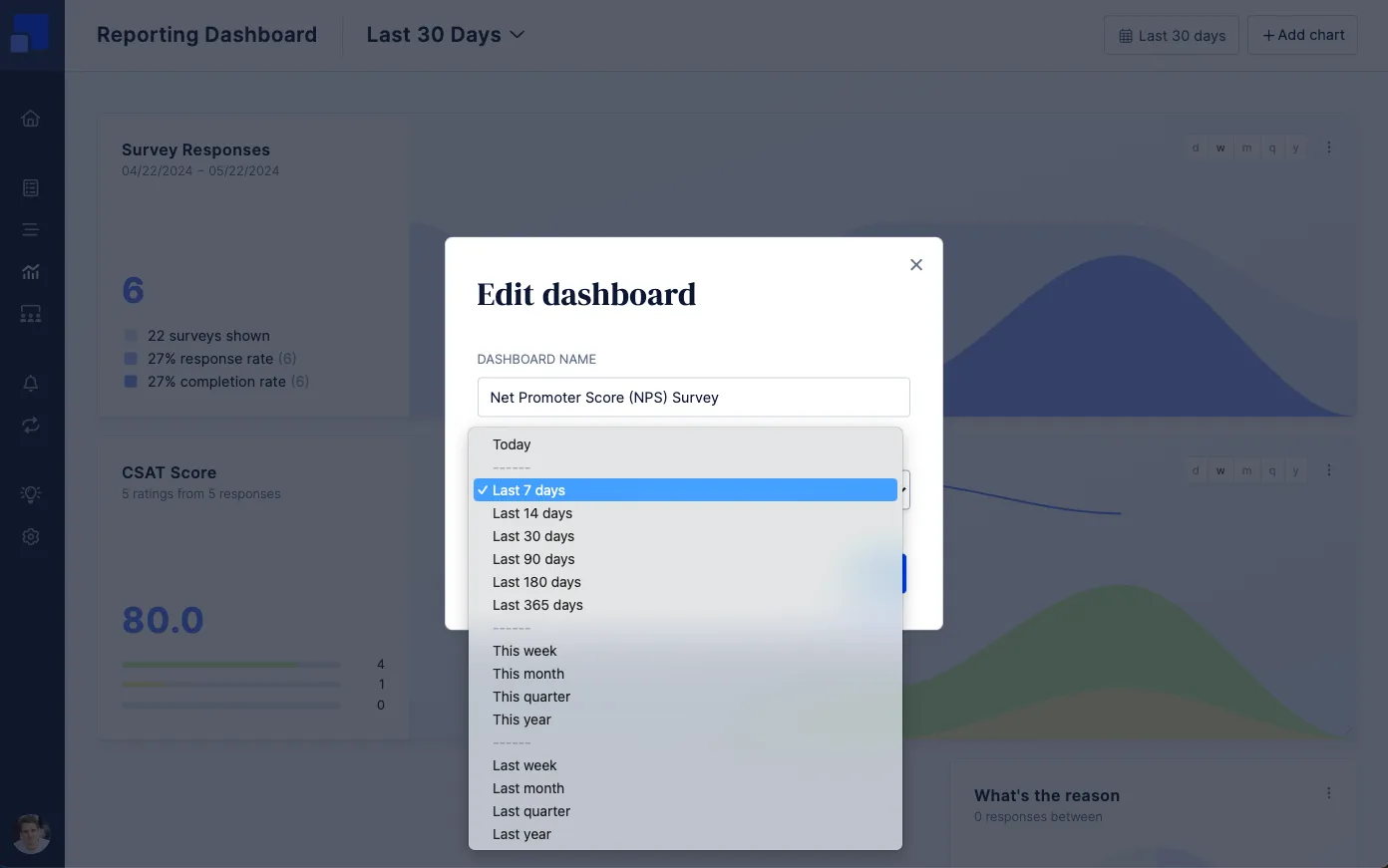
When creating or editing a dashboard, you can choose a default date range. The following default date ranges are available:
- Today
- Last 7, 14, 30, 90, 180, 365 days
- This week, month, quarter, year
- Last week, month, quarter, year